
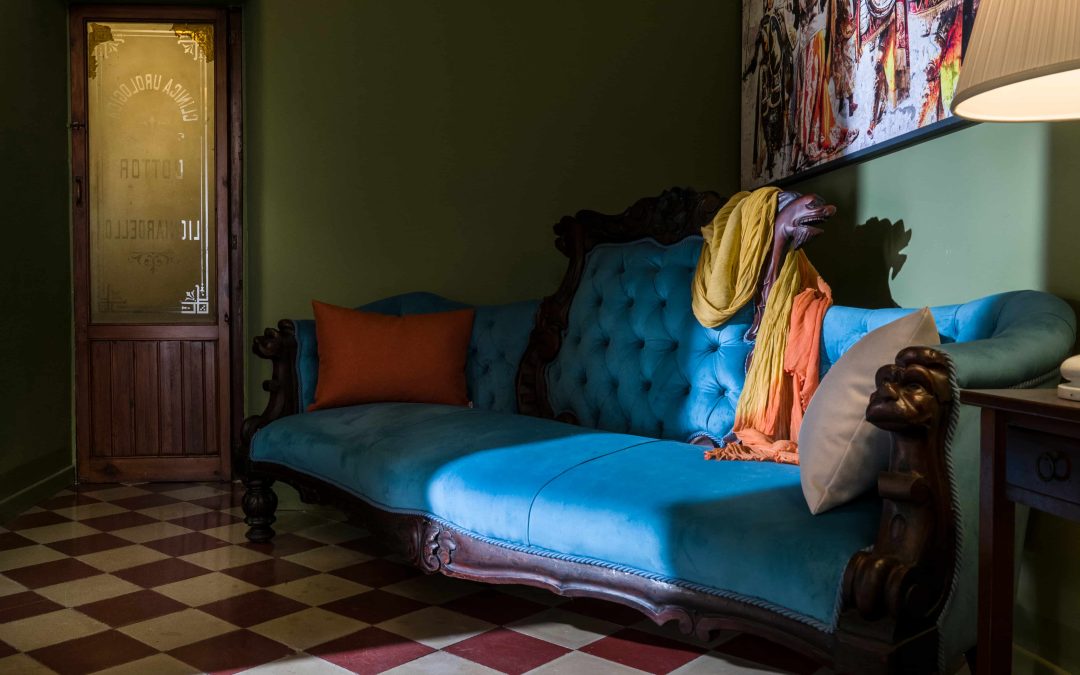
This is the first article in our Writers’ Rooms series — three rooms at Sicilia Encantada, each named after a Sicilian writer who changed literature. Room Verga. Room Pirandello. Room Sciascia.
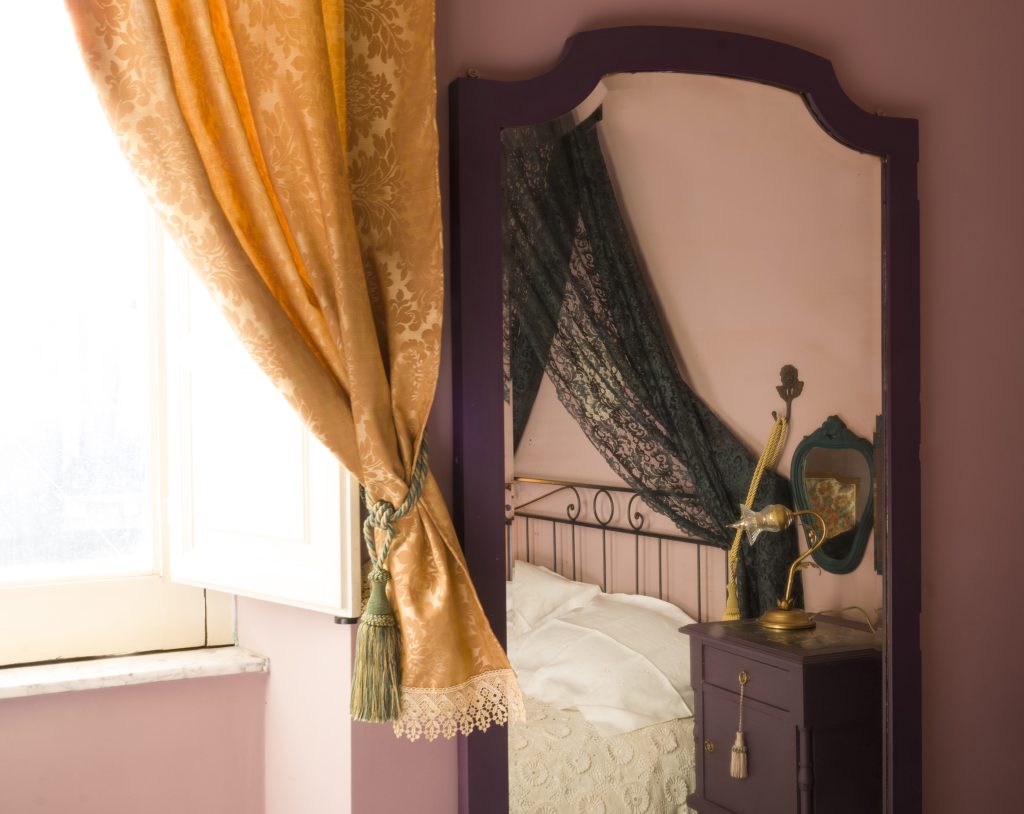
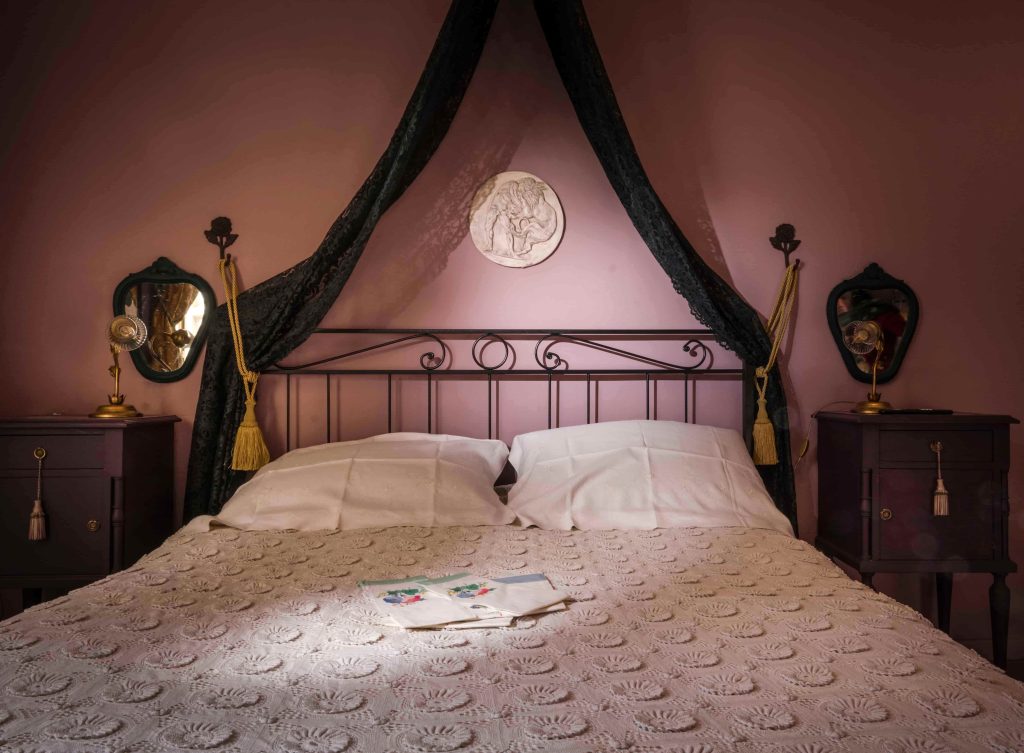
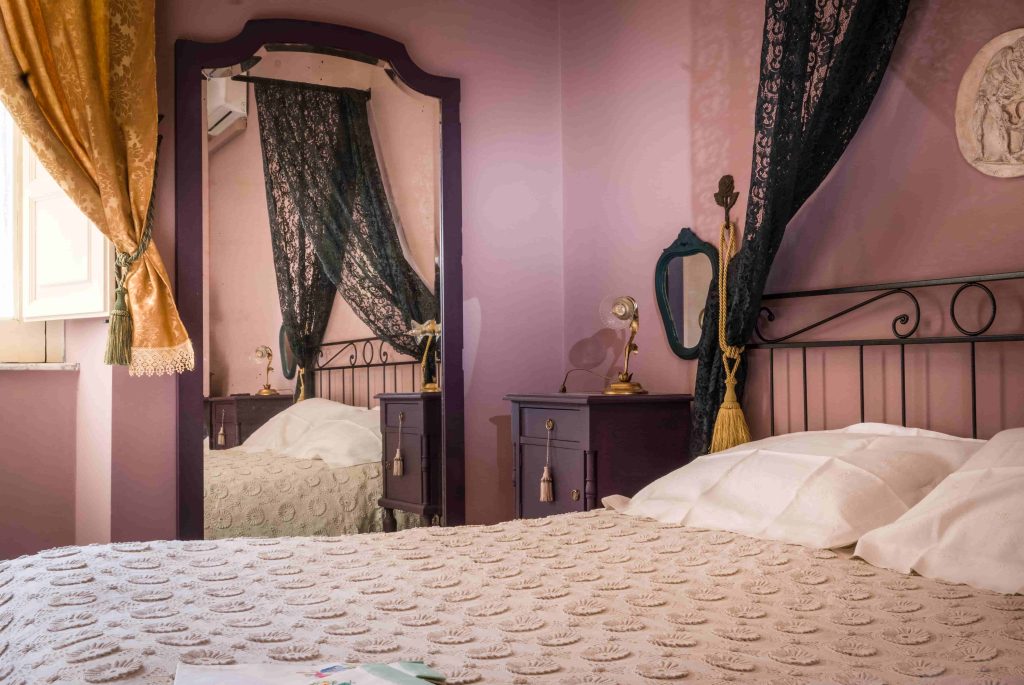
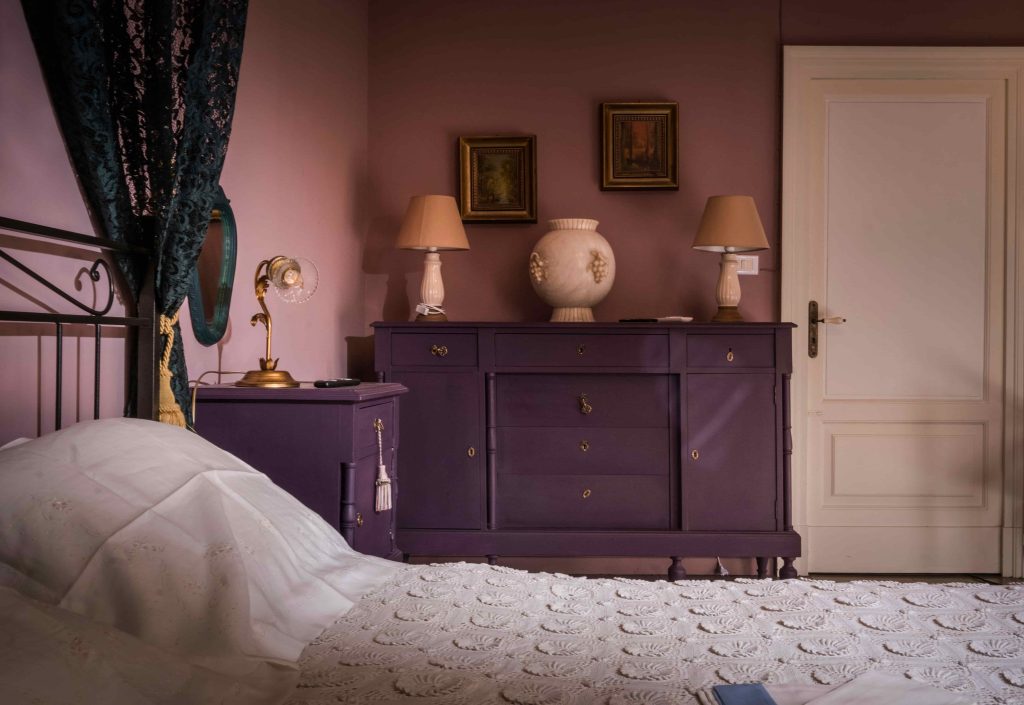
There is a room at Sicilia Encantada with walls the colour of dried lavender. The bed is iron, the headboard scrolled and dark. Black lace falls from the ceiling in a half-canopy, catching the light from the courtyard window and casting a pattern on the antique floor tiles. On the bedside table, a brass lamp with a glass shade. In the full-length mirror framed in deep violet, the room reflects itself back: quieter, slightly more distant, like something remembered rather than seen.
We named this room after Giovanni Verga. It seemed right.
Photography by Giovanni Ruggeri — https://www.bottegaruggeri.it
Who was Giovanni Verga?
Giovanni Verga was born in Catania in 1840, in a Sicily that was not yet Italy. The unification would come only in 1860 — Verga was twenty years old. The language of the streets was Sicilian, not Italian. The poor, the fishermen, the peasants he would later write about had never spoken the language in which he would immortalise them. That tension — between the literary Italian he learned and the Sicilian world he knew — is at the heart of everything he wrote. [1,5]
He spent the first part of his adult life trying to escape: to Florence, to Milan, to the literary salons of the north, where he wrote fashionable society novels that are now entirely forgotten. Then something shifted. Around 1878, Verga began writing about what he actually knew. He returned — in his imagination, and eventually in person — to Sicily. To the fishing villages of the Ionian coast. To the peasants of the Catanian plain. To the world of people for whom survival was not a metaphor but a daily negotiation with the sea, the land, and fate.
What emerged from that return was Verismo — Italian literary realism — and two works that changed everything: the short story collection Vita dei Campi (1880) and the novel I Malavoglia (1881), published in English as The House by the Medlar Tree. A second novel, Mastro-don Gesualdo (1889), followed. Verga never completed the cycle of five novels he had planned. He returned to Catania in 1893 and barely wrote again. He died here in 1922. He was eighty-one years old. [2]
Photography by Giovanni Ruggeri — https://www.bottegaruggeri.it
The language Verga wrote in — and why it matters
The Italian Verga wrote in was not the language of the streets outside this apartment. It was not the language his characters spoke. And it was not, strictly speaking, a language that had existed for very long.
Italian as a literary standard was built in three stages. The first was Sicilian: in the thirteenth century, at the court of Frederick II in Palermo, poets writing in the Sicilian vernacular — among them Giacomo da Lentini, inventor of the sonnet — produced the first body of literature in a Romance vernacular in Italy. [4] Dante himself acknowledged their primacy in De Vulgari Eloquentia. [3] The second stage was Florentine: Dante, Petrarch and Boccaccio in the fourteenth century imposed Tuscan as the model for literary Italian, a position codified by the Accademia della Crusca from 1583 onwards. [6] The third stage was political: Italian unification in 1860 created a nation that needed a single language, and imposed a standardised Italian on populations that mostly spoke dialects. [1]
Verga was born into a Sicily that was still the Kingdom of the Two Sicilies. The people around him spoke Sicilian. When he chose to write in Italian — and to bend that Italian to the rhythms and syntax of Sicilian thought — he was doing something radical: giving a voice, in the language of power, to people who had never had access to it.
Photography by Giovanni Ruggeri — https://www.bottegaruggeri.it
Why Verga still matters
The influence of Verga on world literature is difficult to overstate and consistently underestimated outside Italy. His technique — writing from inside the consciousness of his characters, using the rhythms of their speech, refusing to judge or explain, letting events unfold with the cold neutrality of fate — anticipated not just Italian neorealism in cinema but influenced writers as distant as D.H. Lawrence, who translated Cavalleria Rusticana and Mastro-don Gesualdo into English. [2]
Cavalleria Rusticana — the short story about honour, betrayal and violent death in a Sicilian village — was adapted into an opera by Pietro Mascagni in 1890, and has been performed continuously ever since. It is one of the most performed operas in the world. The story takes place a few hours’ drive from where you are sleeping.
What Verga understood, and what makes him still essential reading, is that the people at the margins of history — the fishermen, the peasants, the women waiting on the shore — have an interior life as complex, as tragic, and as worthy of literature as any aristocrat or intellectual. He wrote about Sicily not as an exotic backdrop but as a world entire in itself.
Photography by Giovanni Ruggeri — https://www.bottegaruggeri.it
The room and what it holds
We chose the colours of Room Verga deliberately. The lavender walls — a colour that feels both intimate and slightly melancholic — seemed right for a writer who spent his life between the longing to escape and the pull of return. The black lace of the half-canopy is the Sicily of his fiction: beautiful, slightly theatrical, shadowed by what cannot be said.
The furniture is antique and Sicilian — the deep violet chest of drawers with brass handles, the bedside tables with their tassel keys, the ceramic lamp, the small paintings in gilt frames. The floor tiles are original to the palazzo, laid in the nineteenth century when Verga was still alive and writing in Milan about the world outside these windows.
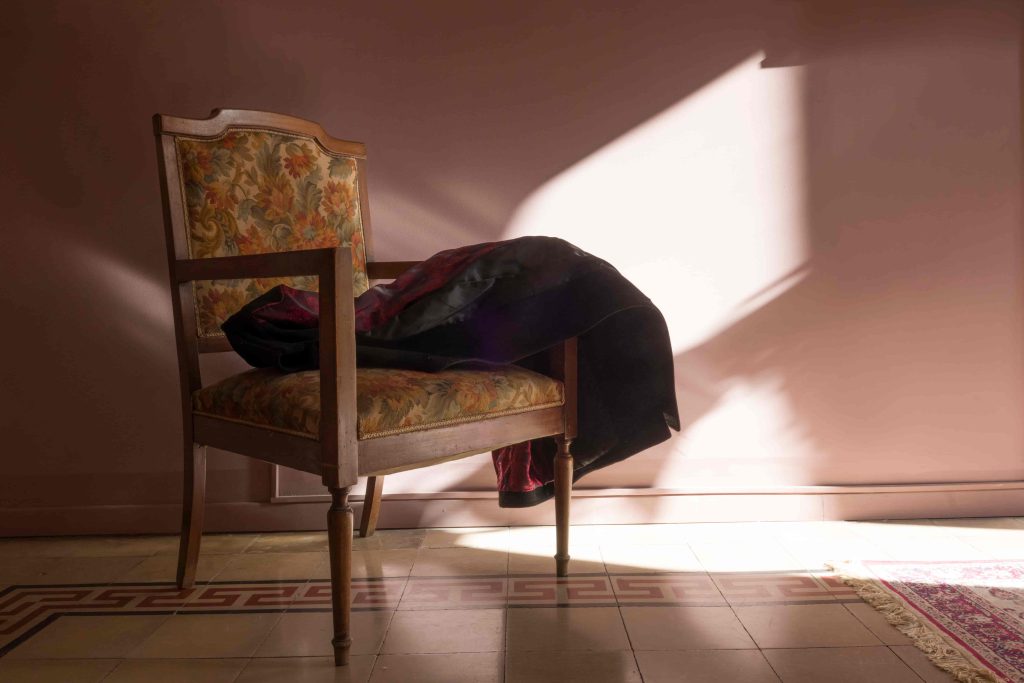
The armchair by the window — upholstered in a faded floral fabric, positioned where the light from the courtyard enters at an angle — is where we imagine him: not writing, but watching. Verga was above all an observer. A man who looked at Sicily long enough and carefully enough to see it clearly.
Photography by Giovanni Ruggeri — https://www.bottegaruggeri.it
What to read in Room Verga
We recommend three works to understand Verga and the world outside your window.
Start with Cavalleria Rusticana and Other Stories — Penguin Classics, available in English. Short, fierce, and entirely Sicilian. Read the title story first. It takes twenty minutes and you will not forget it. [2]
Then The House by the Medlar Tree — I Malavoglia in the original Italian. A fishing family in Aci Trezza, forty minutes from Catania, across three generations of loss. One of the great novels of the nineteenth century that almost no one outside Italy has read. [2]
And if you go to Aci Trezza — and you should — the village still looks something like what Verga described. You will understand why he could not stop writing about this place even when he was trying to.
Verga in Catania today
The house where Verga was born no longer stands. But the city he grew up in is still recognisable in the streets around this apartment. The baroque churches he walked past, the fish market he described, the volcano that dominates every horizon — these are unchanged in their essentials. [1]
The Fondazione Verga (fondazioneverga.it — on Facebook: FondazioneVerga) is based in Catania, inside the ex Monastero dei Benedettini on Piazza Dante Alighieri — a short walk from Sicilia Encantada. It holds Verga’s manuscripts, letters and first editions, and organises events and literary readings throughout the year. Open Monday, Tuesday, Thursday and Friday 8:30–13:30; Wednesday 9:00–13:30 and 15:00–18:00. If it is in the programme during your stay, do not miss it. It is the closest you can get to hearing Verga’s Sicily as sound.
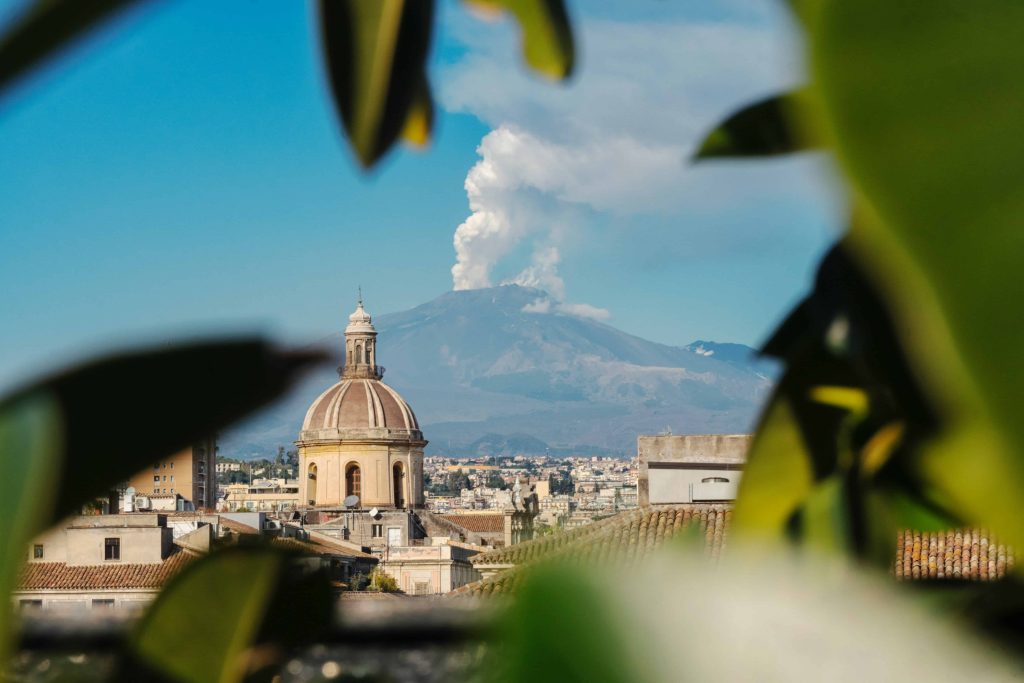
Catania, Sicily — the city where Verga was born in 1840. Photo by Samir Kharrat via Unsplash.
A room with a story
We believe that where you sleep shapes how you travel. Room Verga is not a themed experience — it is a room in an eighteenth-century Sicilian palazzo that happens to carry the name of the writer who looked at this world more clearly than anyone before or since.
Wake up here. Read a page before breakfast. Walk out onto Via Etnea. Look up at Etna. Then tell us you don’t understand why Verga could never quite leave. Reserve Room Verga at Sicilia Encantada https://www.siciliaencantada.com
References
[1] Mack Smith D. A History of Sicily. London: Chatto & Windus; 1968.
[2] Russo L. Giovanni Verga. Bari: Laterza; 1919.
[3] Alighieri D. De Vulgari Eloquentia. c. 1303. [Testo disponibile su: letteraturaitaliana.net]
[4] Migliorini B. Storia della lingua italiana. Firenze: Sansoni; 1960.
[5] Treccani. Verga, Giovanni. In: Enciclopedia Italiana. Roma: Istituto dell’Enciclopedia Italiana. Disponibile su: treccani.it
[6] Vitale M. La questione della lingua. Palermo: Palumbo; 1960.