
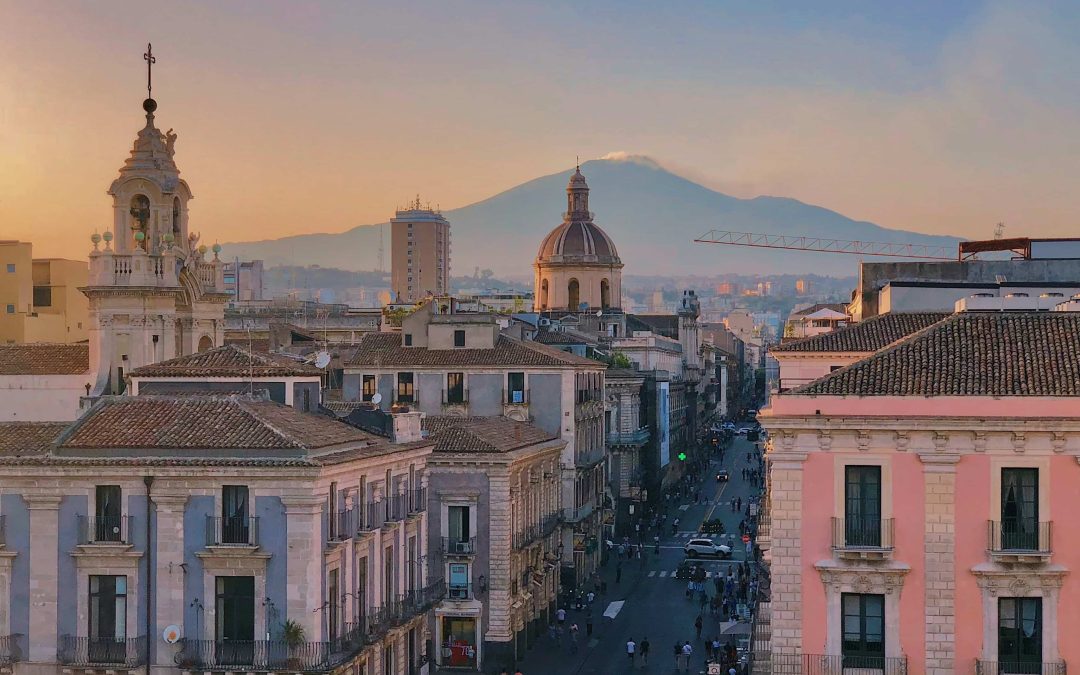
This is the second article in our Writers’ Rooms series — three rooms at Sicilia Encantada, each named after a Sicilian writer who changed literature. Room Verga. Room Pirandello. Room Sciascia.
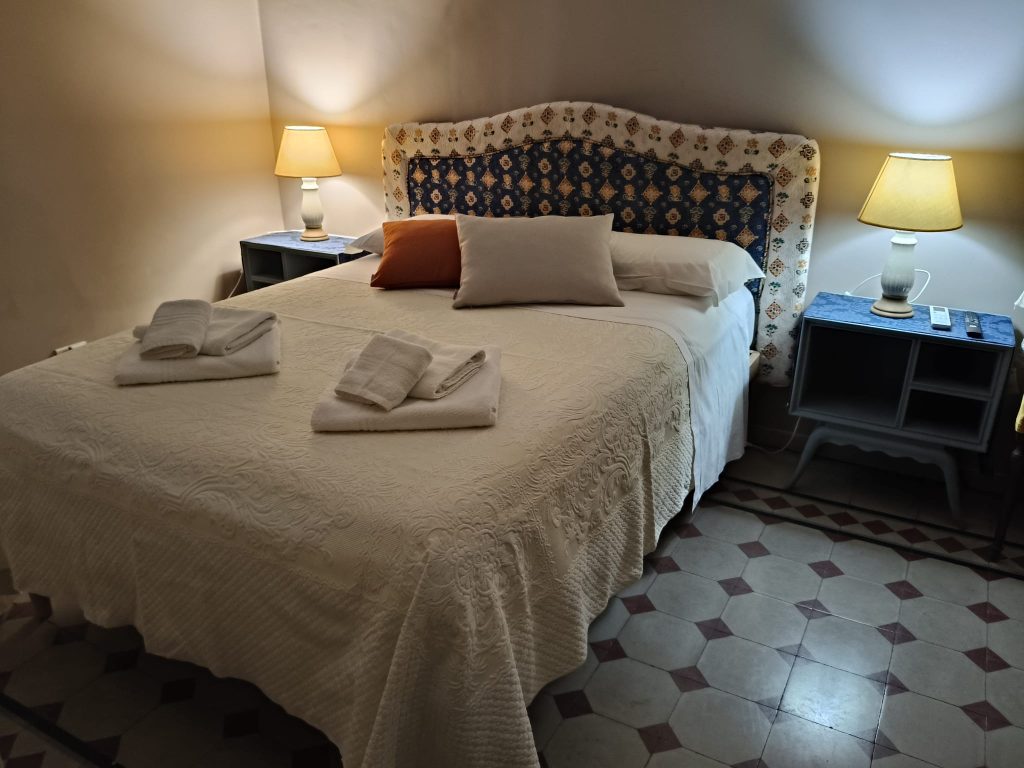
There is a room at Sicilia Encantada with warm ochre walls and a senape yellow chair by the window. The bed has a headboard upholstered in blue and gold damask — the colours of a Sicilian baroque church, or a playing card, or a theatre curtain about to open. The floor tiles are original: terracotta hexagons with burgundy diamonds, worn smooth by more than a century of footsteps. Green lace curtains filter the light from the courtyard.
It is a room that looks, at first glance, entirely Sicilian. And then you notice that it is also a room about something else entirely. Which is exactly what Leonardo Sciascia always was.
Who was Leonardo Sciascia?
Leonardo Sciascia was born in Racalmuto, a small town in the province of Agrigento, in 1921. He spent most of his life in Sicily — teaching in elementary schools, writing, reading, arguing — and he died in Palermo in 1989. He was sixty-eight years old. In the forty years between his first major work and his death, he produced one of the most distinctive and uncomfortable bodies of writing in twentieth-century European literature. [1]
He was not, first of all, a novelist. He was a moralist. A detective. A man who asked questions that powerful people preferred not to answer. His books look like crime fiction — and some of them are — but what he was really investigating, in every work, was the same thing: who has power, how they hold it, and what they are willing to do to keep it.
Sicily was his laboratory. Not because the island was unique — but because it was, in his words, the most extreme expression of something universal. The mafia, the silence, the collusion between crime and the state: these were not Sicilian problems. They were human problems, made visible in Sicily because the light there was so clear and the shadows so deep. [2]
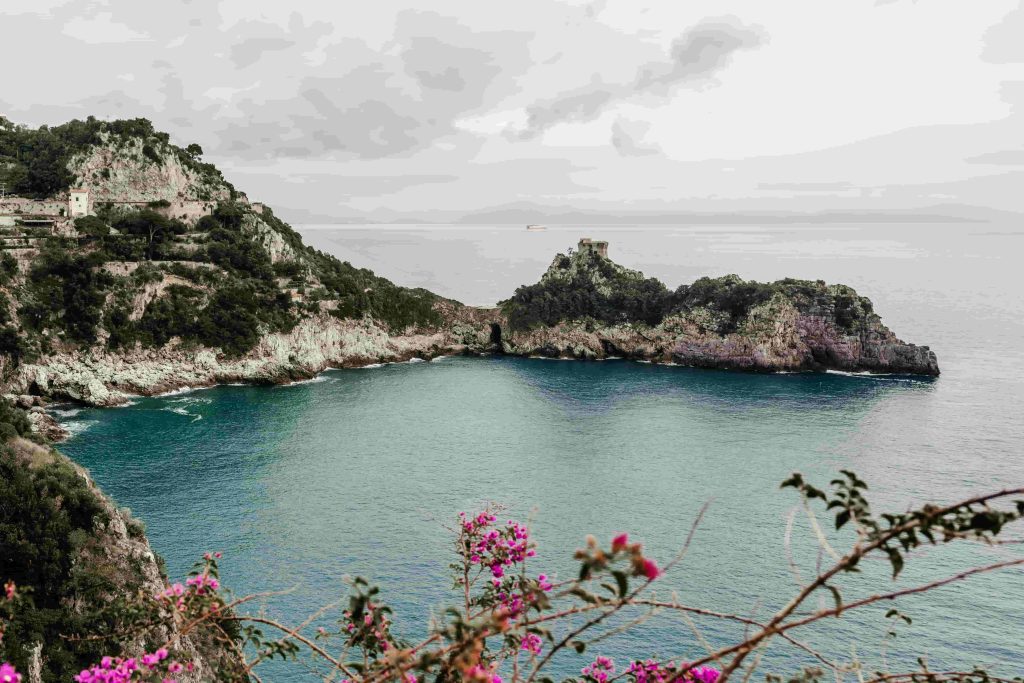
Photo by Ryan Ancill via Unsplash.
Il giorno della civetta — The Day of the Owl
Published in 1961, Il giorno della civetta — The Day of the Owl in English — was the first Italian novel to deal openly with the mafia. This was not a small thing. The mafia, at that time, was officially considered not to exist. Politicians denied it. Judges ignored it. Newspapers avoided it. Sciascia wrote a novel about it. [3]
The book follows Captain Bellodi, a northern Italian police officer sent to Sicily, as he investigates a murder that everyone around him insists did not happen. What he discovers — about the structure of power, about who protects whom, about the wall of silence that makes justice impossible — is not just a Sicilian story. It is a story about how power works everywhere.
Sciascia understood three things that made him unlike any other Italian writer of his generation. He understood that silence is a form of speech. He understood that complicity is rarely dramatic — it is almost always ordinary, quiet, and entirely reasonable to those who practice it. And he understood that the truth, when it is found, rarely changes anything — which does not mean it should not be sought.
Sicily as a metaphor for the world
This is what makes Sciascia unlike Verga or Pirandello. Verga wrote about Sicily because it was his home and he could not escape it. Pirandello wrote about Sicily as a place of psychological extremity. Sciascia wrote about Sicily because it was useful — because the island, with its particular history of conquest, occupation and accommodation, made visible what other places preferred to keep hidden.
His other major works — A ciascuno il suo (To Each His Own, 1966), Il contesto (Equal Danger, 1971), Todo modo (One Way or Another, 1974) — extend the same investigation into increasingly abstract territory. The enemy is no longer just the mafia. It is the Catholic Church, the political parties, the judiciary, the state itself. His targets changed. His method did not. [1,2]
He was accused, in his later years, of being too pessimistic. Of denying the possibility of change. He responded, characteristically, with a question: show me the evidence.
The room and what it holds
Room Sciascia at Sicilia Encantada has a quality that the other rooms do not: it is warm without being comfortable. The ochre walls and the lamplight create an atmosphere that feels enclosed, concentrated — the right conditions for reading something that demands attention.
The blue and gold damask headboard is theatrical in the way that Sciascia’s prose is theatrical — formal on the surface, concealing something more disturbing underneath. The senape yellow chair by the window is where you should sit with Il giorno della civetta on a quiet afternoon, with the sounds of Catania coming up from the courtyard below.
The original floor tiles — the same terracotta hexagons that run through the palazzo — connect this room to everything around it: to the city, to the century, to the Sicily that Sciascia spent his life trying to understand.
What to read in Room Sciascia
We recommend three works, in order of difficulty and darkness.
Start with Il giorno della civetta — The Day of the Owl in the New York Review Books English translation. It is short, precise and devastating. Read it in one sitting if you can. It takes about two hours and you will finish it differently from how you started. [3]
Then A ciascuno il suo — To Each His Own. A professor investigates a double murder in a Sicilian town and discovers that knowing the truth and being able to act on it are entirely different things. It is Sciascia’s most perfectly constructed novel. [1]
And if you want to understand why Sciascia matters beyond Italy, read his essay La Sicilia come metafora — Sicily as Metaphor. It is a long interview, available in English, in which he explains exactly what he was trying to do and why. It is the clearest thing he ever wrote, and the most useful key to everything else.
Sciascia in Sicily today
Racalmuto — the town where Sciascia was born and to which he always returned — is ninety minutes from Catania by car. Three places are worth visiting. [1]
The Fondazione Leonardo Sciascia (fondazioneleonardosciascia.it — @fondazione_leonardo_sciascia on Instagram) holds his personal library, his manuscripts, his correspondence across fifty years of literary activity, and the first editions of all his books in every language. The building itself — a former electrical power station converted by architect Antonio Foscari — is extraordinary. It organises events and conferences throughout the year.
CasaSciascia (fondoambiente.it/luoghi/casasciascia — on Facebook: CasaSciascia Racalmuto) is the house where Sciascia spent his childhood and adolescence — the house he described in his writing, where he first developed his passion for reading. It is now open to visitors and managed as a cultural centre. Some of the original furniture remains.
Every summer, Racalmuto also hosts the Festival del Tarallo — a celebration of the town’s signature sweet biscuit, glazed with lemon, which Sciascia himself wrote about and always kept at home. It is a small, genuine event that connects food, memory and literature in exactly the way Sciascia would have approved of.
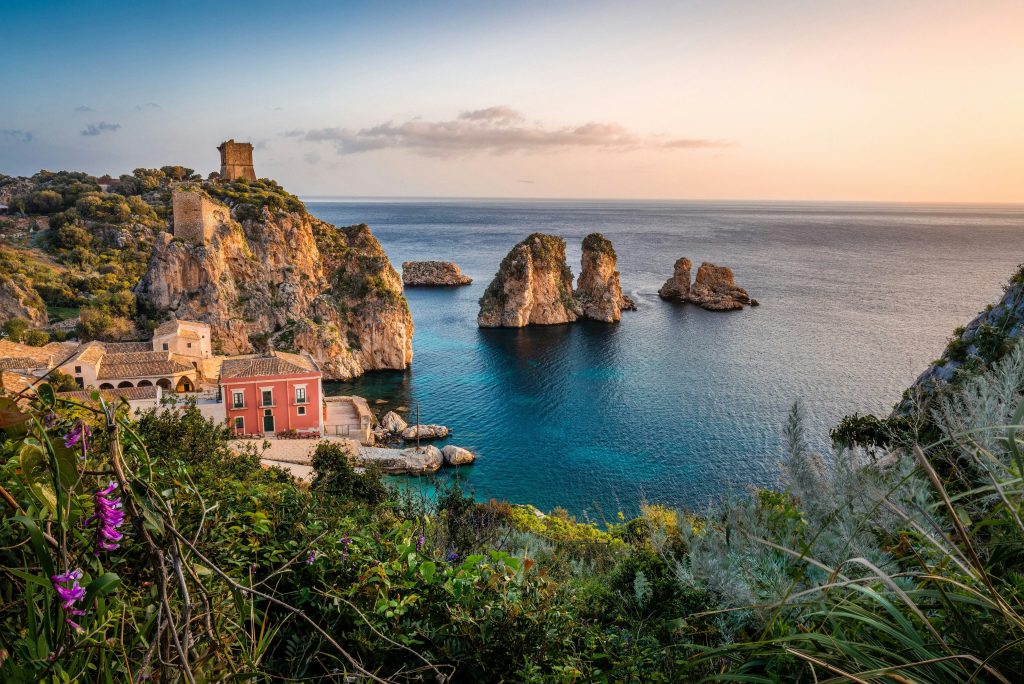
Photo by Sam Ferrara via Unsplash.
A room with a question
Room Sciascia does not offer easy sleep. It offers something more valuable: the right conditions for thinking clearly about difficult things. The warm light, the enclosed atmosphere, the silence of a palazzo that has seen everything and said nothing — these are the conditions in which Sciascia did his best work.
Wake up here. Make coffee. Sit in the yellow chair. Open Il giorno della civetta at page one. By the time you reach page fifty, you will understand something about Sicily — and something about everywhere else — that you did not know before.
Reserve Room Sciascia at Sicilia Encantada — siciliaencantada.com
The Writers’ Rooms series: Room Verga — Room Pirandello — Room Sciascia.
References
[1] Ambroise C. Invito alla lettura di Sciascia. Milano: Mursia; 1974.
[2] Onofri M. Storia di Sciascia. Bari: Laterza; 1994.
[3] Sciascia L. Il giorno della civetta. Torino: Einaudi; 1961.
[4] Treccani. Sciascia, Leonardo. In: Enciclopedia Italiana. Roma: Istituto dell’Enciclopedia Italiana. Disponibile su: treccani.it